
Aircraft at the 2015 show
These aircraft have already confirmed attendance at the 2015 show, but there's even more to come...
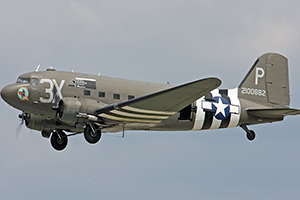
BBMF Dakota
The C-47 Dakota was manufactured in the USA by Douglas in March 1942 and initially issued to the United States Army Air Force. In September that year the aircraft was transferred to the Royal Canadian Air Force (RCAF) and served in Canada during World War Two. It was subsequently deployed to Europe with the RCAF until declared surplus to requirements by the Canadians in 1971.The Royal Aircraft Establishment (RAE) at Farnborough then purchased the aircraft, which was allocated the UK military serial number KG661, as it had carried the serial ‘661’ with the Canadians. During her time with the RAE, the Dakota was used for a variety of tasks and trials, including dropping sonabuoys through holes cut in the fuselage and for launching remotely piloted vehicles. Cleared for dropping paratroops, she often displayed in this role and occasionally appeared in the static park at air shows. For some time, however, there had been doubt about the allocated serial number. Research showed that the serial ‘KG661’ had previously belonged to a Dakota that had been destroyed in an accident. So the serial number was changed to a new one - ZA947. In 1992 the Defence Research Agency, the successor to the RAE, declared ZA947 surplus to requirements.
The aircraft was adopted by Strike Command and issued to the BBMF in March 1993. In 2004, an original and authentic floor and interior was re-fitted to the Dakota, returning the cabin to the original, wartime specification. As there are now no other multi-engine tail wheel aircraft in RAF service outside the BBMF, the Dakota is an important training asset used for initial training of aircrew for the BBMF multi-engine aircraft and for renewing the currency of the Flight’s Lancaster pilots each year. In addition to this role though, the Dakota is a sought-after display aircraft in her own right and, as such, she appears regularly on the air show circuit either on her own or as part of a BBMF formation. She continues to be capable of para-dropping and is used in that role for special commemorative events.
ZA947 is now painted to represent Dakota FZ692 of No 233 Squadron, around the D-Day period in 1944. This aircraft, which was named ‘Kwicherbichen’ by her crews, was involved in Para-dropping operations on the eve of D-Day and subsequently in re-supply and casualty evacuation missions into and out of forward airfields in the combat areas. The female nurses who escorted the casualties on these flights became known as ‘The Flying Nightingales’. By the end of 1944, 1,092 stretcher cases and 467 sitting wounded had been evacuated to England by the 233 Squadron Dakotas.
To read more about the 233 Squadron operations, Dakota FZ692 ‘Kwicherbichen’ and aeromedical casualty evacuation in 1944 and today click here.

BBMF Hurricane
LF363 was built at the Hawker factory at Langley near Slough. It first flew in January 1944 and is believed to be the last Hurricane to enter service with the RAF. The aircraft served with No 63 Squadron at Turnhouse, No 309 (Polish) Squadron at Drem, where it was used on shipping protection patrols off the east coast of Scotland, and No 26 Squadron with whom it flew naval artillery spotting and reconnaissance sorties before the end of the War.LF363 was then stored in the open air at Langley, waiting to be scrapped. Fortunately, it was rescued in mid-1949, largely through the intervention of Air Commodore (later Air Vice Marshal) Stanley Vincent CB, DFC, AFC. After arranging for LF363 to be made airworthy, Stanley Vincent himself led the Battle of Britain flypast over London in the aircraft in September 1949.
Between 1949 and 1956, LF363 was held and maintained, rather unofficially, by a series of front-line squadrons and Station Flights, being flown on ceremonial occasions and appearing in various films. After a major re-fit at Hawkers, LF363 became a founding aircraft of the Historic Aircraft Flight, the forerunner of the BBMF, when it was formed in 1957.
LF363 suffered a major accident on 11th September 1991 when, as a result of an engine failure it crashed on the runway at RAF Wittering. The aircraft was seriously damaged by the impact and the ensuing fierce fire; fortunately the BBMF pilot escaped with a broken ankle and minor burns. Subsequently, LF363 was re-built by Historic Flying Ltd between 1994 and 1998 and then re-joined the BBMF after 7 years out of action.
Hurricane LF363 has been undergoing a ‘major’ servicing in the BBMF hangar during the winter of 2013/14, during which it has been stripped of its fabric and taken back to its ‘bare bones’. Since 2014, LF363 has been painted to represent Hurricane Mk 1 P3395 ‘JX-B’, the personal aircraft of Sergeant Pilot Arthur ‘Darkie’ Clowes DFM, of No 1 Squadron, during the Battle of Britain. Clowes’ Hurricane had a fearsome looking wasp painted on both sides of the nose.
To find out more about Arthur Clowes and his Hurricane click on this link.
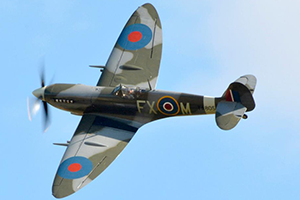
BBMF SPITFIRE
Produced in greater numbers than any other British combat aircraft before or since the War, 20,341 Spitfires were built in 22 different variants (excluding the navalised Seafire) and the aircraft remained in production for 12 years.The prototype’s maiden flight took place on 5th March 1936 and Mk1 Spitfires entered RAF service (with No 19 Squadron) in August 1938.
The development potential of the original design allowed the Spitfire to establish and then maintain the air superiority so vital to the defence of Britain and to keep pace with the improvements in performance of enemy fighters throughout World War Two.
Spitfires fought in every operational theatre of the War and remained in RAF front-line service up to 1954. At the end of its development the Spitfire carried an engine producing more than twice the power of the original, its maximum take-off weight and rate of climb had more than doubled, its firepower had increased by a factor of five and its maximum speed had been increased by a third; all this in essentially the same airframe.
The Spitfire played a major part in achieving ultimate victory in World War Two and truly deserves its place as probably the most successful fighter design ever, and certainly as the most famous and charismatic of all time.